Today's date is: September 19, 2026
Genesis Chapter 5
📝Summary
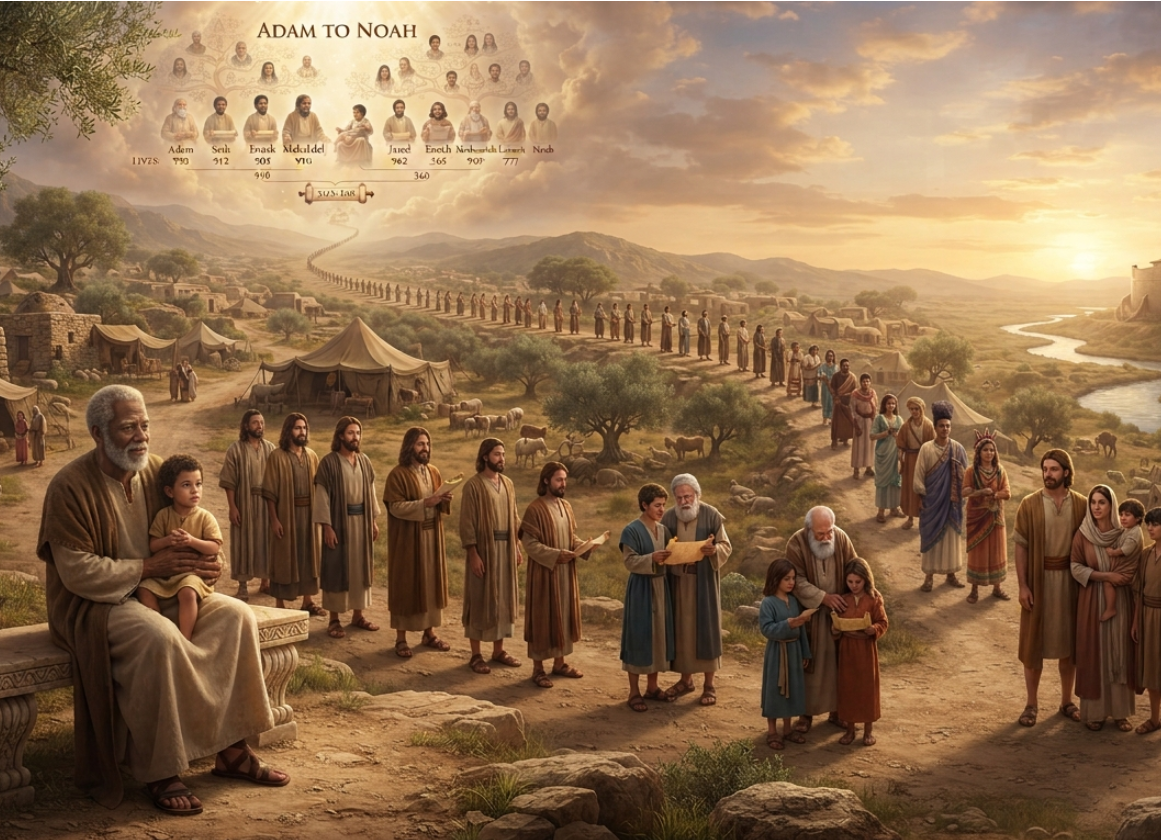
Genesis Chapter 5 serves as a vital historical and theological bridge that outlines the godly lineage from Adam to Noah through his third son, Seth, spanning roughly 1,656 years of the pre-flood (antediluvian) era. Structurally, it transitions the biblical narrative from the immediate aftermath of the Fall and Cain's rebellious line (Genesis 4) to the widespread corruption and judgment of the global Flood (Genesis 6).
🏛️ The Imagery of God vs. The Imagery of Man (Verses 1–3)
The chapter opens by deliberately echoing the Creation account of Genesis 1:27. It reminds the reader that God created humanity in His own likeness, both male and female, and blessed them. However, a subtle yet profound shift occurs in verse 3:
- The Shift: Adam fathers Seth not in the explicit image of God, but "in his own likeness, after his image".
- Theology: This signifies the transmission of the fallen, sinful human nature introduced in Genesis 3. While the intrinsic value of the Imago Dei (Image of God) remains, it is now marred by sin, affecting all subsequent generations.
⏱️ Chronological Breakdown & The Rhythm of Death
The structural rhythm of the chapter is famously repetitive: A patriarch lives X years, fathers a son, lives Y more years having other children, lives a total of Z years, and he died. This relentless repetition underscores the literal fulfillment of God's warning in Genesis 2:17—that sin would bring physical death into the world.
The text outlines extreme lifespans, which scholars attribute to pristine post-creation genetics and a protective pre-flood environment.
| Patriarch | Age at Firstborn's Birth | Remaining Years | Total Lifespan | Historical / Theological Significance |
|---|---|---|---|---|
| Adam | 130 | 800 | 930 | The first man; establishes the baseline of physical death. |
| Seth | 105 | 807 | 912 | The replacement line for Abel; the lineage of promise. |
| Enosh | 90 | 815 | 905 | His era marked the time people began to "call on the name of the Lord" (Gen 4:26). |
| Kenan | 70 | 840 | 910 | Continued the preservation of the chosen seed line. |
| Mahalalel | 65 | 830 | 895 | Shortest lifespan among those who suffered natural death in this chapter. |
| Jared | 162 | 800 | 962 | Second-longest lifespan recorded in biblical history. |
| Enoch | 65 | 300 | 365 | Did not die; walked with God and was taken directly to heaven. |
| Methuselah | 187 | 782 | 969 | The longest human life; died the exact year the flood began. |
| Lamech | 182 | 595 | 777 | Prophesied that his son would bring rest from the cursed ground. |
| Noah | 500 | Father of Shem, Ham, and Japheth; custodian of the Ark. |
💫 Breaking the Pattern: Enoch and Lamech
The monotonous drumbeat of "and he died" is intentionally interrupted by two specific individuals, highlighting God's grace and prophetic plan:
- Enoch’s Translation (Verses 21–24): Enoch breaks the curse of death. The text notes that Enoch "walked with God" for 300 years, implying a deep, intimate fellowship. Instead of dying, "he was not, for God took him." This serves as an early Old Testament testament to life after death and victory over the grave.
- Lamech’s Prophecy (Verses 28–29): When Lamech fathers Noah, he breaks the sterile genealogical formula to name him Noach (meaning "Rest" or "Comfort"). He proclaims, "This one will comfort us concerning our work and the toil of our hands, because of the ground which the Lord has cursed." This introduces the theme of a coming deliverer who will carry humanity through judgment into a refreshed creation.
🎯 Key Theological Conclusions
- The Sovereignty and Truth of God: The chapter acts as proof that God keeps His word—both in the execution of judgment (death reigning over humanity) and the preservation of grace (the lineage of the Messiah remains intact).
- The Line of the Promise: By intentionally bypassing Cain’s line, Genesis 5 focuses purely on Seth. It sets up the legal and ancestral framework that leads directly to King David and, ultimately, to Jesus Christ (as tracked in Luke 3).