Today's date is: September 19, 2026
The Meeting at the Well: Divine Guidance and Hospitality in Genesis 24
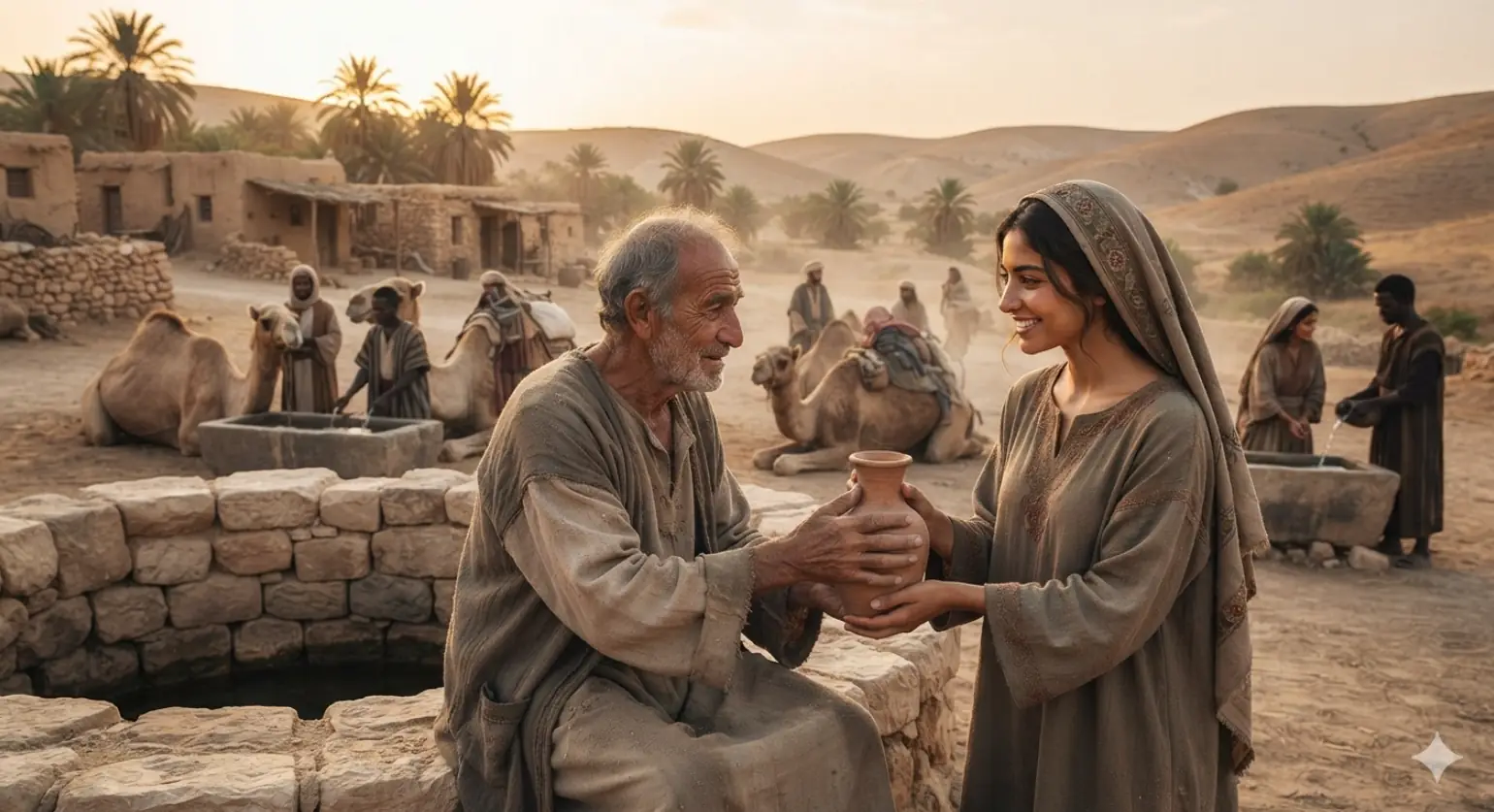
The primary theme of Genesis Chapter 24 centers around divine guidance, hospitality, and the fulfillment of family covenant through the meeting of Rebekah and Abraham's servant (traditionally Eliezer) at the well.
🗺️ Context and Background
Genesis Chapter 24 is the longest chapter in the Book of Genesis, focusing entirely on the mission to find a wife for Isaac.
This narrative serves as a critical transition in patriarchal history, ensuring the continuity of God’s covenant promises from Abraham to the next generation through the introduction of Rebekah.
At this point in the narrative, Sarah has passed away (Genesis 23), and Abraham is very old.
God has promised Abraham that his descendants will become a great nation and inherit the land of Canaan.
However, Isaac is still unmarried.
To prevent Isaac from marrying a Canaanite woman—which would compromise the family's spiritual and cultural identity—Abraham takes action to secure a bride from his own kindred in Mesopotamia.
📑 Structural Outline
- Abraham’s Charge to His Servant (vv. 1–9)
- The Two Conditions:
The bride must come from Abraham's native land, and Isaac must not leave Canaan to go there.Abraham expresses absolute faith that God will send His angel ahead of the servant to find the right woman.
- The Servant’s Prayer and Sign (vv. 10–14)
- The Arrival and Character of Rebekah (vv. 15–27)
- Hospitality and the Proposal (vv. 28–49)
- Family Consent and Rebekah's Choice (vv. 50–61)
- 6. The Meeting of Isaac and Rebekah (vv. 62–67)
Abraham makes his oldest and most trusted servant (traditionally identified as Eliezer) take a solemn oath.
The servant places his hand under Abraham’s thigh—an ancient, deeply binding gesture of fidelity.
The servant travels to the city of Nahor in Aram-naharaim with ten camels packed with gifts.
He stops at a well outside the city at evening, when women come to draw water.
He prays a highly specific prayer, asking God for a sign of hesed (steadfast love/faithfulness) toward Abraham: the chosen woman will not only give him a drink but will proactively offer to water his camels as well.
Before the servant finishes praying, Rebekah, the granddaughter of Abraham’s brother Nahor, arrives.
She is described as beautiful and virtuous.
When asked for a drink, she quickly obliges and then undergoes the exhausting labor of drawing water for all ten camels. Recognizing the answered prayer, the servant rewards her with gold jewelry and asks who she is.
Upon learning her lineage, he bows down and worships God for His guidance.
Rebekah runs home to tell her family.
Her brother, Laban, seeing the gold, rushes out to invite the servant into their home with lavish hospitality.
Before eating, the servant insists on delivering his message.
He recounts Abraham’s wealth, the birth of Isaac, the oath he took, and the exact miraculous sign that just occurred at the well.
He then asks Laban and Bethuel (Rebekah’s father) for her hand in marriage.
Laban and Bethuel recognize that "the thing comes from the Lord" and give their consent.
The servant presents more gifts of silver, gold, and clothing.
The next morning, the servant wants to leave immediately, but the family asks for a delay of ten days.
They decide to let Rebekah make the final choice.
Rebekah resolutely answers, "I will go."
The caravan returns to Canaan.
Isaac is out in the field meditating in the evening when he spots the camels.
Rebekah sees Isaac, veils herself out of modesty and cultural respect, and dismounts.
The servant reports the journey to Isaac.
Isaac brings Rebekah into his late mother Sarah’s tent; she becomes his wife, he loves her, and he finds comfort after his mother’s death.
🔑 Key Themes
- Providence and Divine Guidance:
The chapter heavily emphasizes God's invisible hand steering human events.God does not speak directly in this chapter; instead, He works through answered prayers, natural timing, and human willingness.
- Covenant Continuity:
Finding a wife for Isaac ensures that the lineage of the promise remains intact.Rebekah is portrayed as a second Sarah, stepping into her physical and spiritual tent to continue the covenant family.
- Character through Service:
Rebekah’s willingness to water ten thirsty camels—which could drink up to 20–30 gallons of water each—demonstrates incredible industriousness, kindness, strength, and hospitality.
- The Power of Prayer and Gratitude:
Abraham's servant models a faithful life.He prays specifically before acting, watches intently for God's response, and immediately stops to worship and give thanks when his prayer is answered.
📊 Character Summary
| Character | Role / Traits in Chapter 24 |
|---|---|
| Abraham | Aging, full of faith, fiercely protective of God's geographic and cultural boundaries for Isaac. |
| The Servant | Loyal, prayerful, wise, and deeply attribute-focused rather than looking purely for status. |
| Rebekah | Generous, energetic, decisive, and brave enough to leave her homeland for an unknown future (echoing Abraham's original call in Genesis 12). |
| Laban | Hospitable, though noticeably motivated and quick to react when he sees wealth and gold. |
| Isaac | Reflective, trusting of his father's arrangements, and capable of deep love and grief. |