Today's date is: September 19, 2026
Genesis Chapter 18
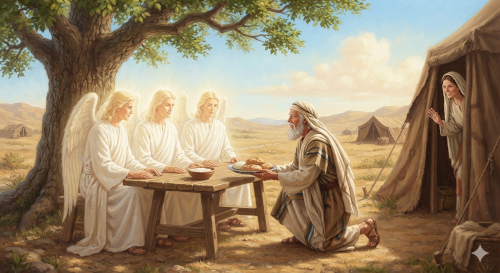
Genesis Chapter 18 emphasizes divine promise, radical hospitality, and the power of intercessory prayer.
Detailed Analysis of Genesis Chapter 18
Genesis Chapter 18 stands as one of the most intimate, dramatic, and theological chapters in the Old Testament. It presents a striking transition from the lavish, earthly hospitality of Abraham's tent to the cosmic, judicial intercession over the impending doom of Sodom and Gomorrah.
Set around 1897 BC near the Oaks of Mamre in Hebron, this chapter serves as a profound meditation on the accessibility of God, the human struggle with doubt, and the weight of divine justice.
1. The Narrative Structure
The chapter naturally divides into two core narrative movements:
- Verses 1–15:
Divine Hospitality and the Reaffirmed Promise.Abraham receives three mysterious visitors, provides a feast, and God promises that the 90-year-old Sarah will bear a son within a year.
- Verses 16–33:
The Judgment of Sodom and Abraham’s Intercession.The scene shifts toward the wicked cities of the plain.God reveals His plans to Abraham, prompting Abraham to bargain for the lives of the righteous.
2. Major Theological Themes & Analysis
Theophanies, Christophanies, and the Trinity (Verses 1–3)
The text opens with a fascinating linguistic tension: “And the Lord appeared to him... behold, three men were standing in front of him.”
- Linguistic Duality:
Abraham alternates between addressing the visitors in the singular ("My Lord") and the plural.
- Christian Theological Interpretations:
Historically, Christian scholars view this scene in two ways. Some see it as an early, visual shadow of the Trinity (three persons, one Lord).Others interpret it as a Christophany—a pre-incarnate appearance of Jesus Christ—accompanied by two angels (who later journey down to Sodom in Chapter 19).
Radical Hospitality as Worship (Verses 4–8)
Abraham’s response to the strangers defines the ancient Near Eastern standard for hospitality, but it is elevated here to an act of worship.
- Humility vs. Abundance:
Abraham tells the guests he will fetch a "morsel of bread" and a "little water".Yet, he runs to have Sarah bake cakes out of three seahs of fine flour (enough to feed an army) and slaughters a tender, choice calf.
- Active Service:
While the visitors eat, Abraham does not sit with them; he stands by them under the tree like a servant awaiting orders.
| Promised/Offered | Actual Provision | Theological Significance |
|---|---|---|
| A little water | Foot washing & rest under the shade | Humility and refreshment |
| A morsel of bread | Three seahs of fine flour cakes | Unstinting generosity, giving God the absolute best |
| Quick rest | Fresh curds, milk, and a tender calf | Humility in speech, but lavishness in action |
From Disbelief to Joy: Sarah’s Laughter (Verses 9–15)
When the Lord states that Sarah will have a son by the same time next year, Sarah—listening behind the tent door—laughs to herself.
- The Reality of Human Limitation:
Sarah's laughter is not malicious; it is rooted in the stark, biological impossibility of her circumstances (she is 90 and post-menopausal).
- The Omniscience of God:
The Lord exposes her hidden, internal laughter.He asks the definitive question of the text: "Is anything too hard for the Lord?"
- The Grace of Fulfillment:
Though Sarah denies laughing out of fear, God does not revoke the promise.Her skepticism is ultimately redeemed when the child is born and named Isaac, which literally means "Laughter"—transforming a laugh of doubt into a laugh of pure joy.
Abraham the Intercessor: Bargaining with God (Verses 16–33)
The second half of the chapter transitions from the personal promise of a child to global justice. God decides to disclose His plans regarding Sodom to Abraham because Abraham is chosen to teach his children righteousness and justice (Gen 18:19).
- The Audacity of Prayer:
Recognizing that his nephew Lot lives in Sodom, Abraham stands before the Lord and negotiates for the city's survival.He appeals directly to God’s nature: "Shall not the Judge of all the earth do what is just?" (Gen 18:25).
- The Incremental Negotiation:
Abraham pushes the boundary of divine mercy, asking God to spare the city if 50 righteous people are found.He methodically drives the number down to 45, 40, 30, 20, and finally 10 righteous people.
- A Heart for the Wicked:
Abraham’s intercession reveals his transformation into a true leader.He does not gloat over the impending destruction of a wicked neighbor; instead, his heart is filled with heavy, active compassion for those facing judgment.God agrees to spare the city for the sake of just ten people, demonstrating that His mercy fiercely looks for reasons to spare, rather than simply reasons to destroy.
3. Literary and Historical Context
Genesis 18 acts as a crucial setup for Genesis 19 (the destruction of Sodom) and Genesis 21 (the birth of Isaac). It highlights a sharp contrast in character: while Abraham welcomes strangers with honor and righteous protection, the citizens of Sodom welcome strangers with hostility and predatory violence.
Furthermore, this chapter cements Abraham's unique status not just as a recipient of a covenant, but as a "friend of God"—someone whom the Creator of the universe chooses to brief on cosmic events before they unfold.