Today's date is: September 19, 2026
The Twins of Destiny: Birth and Legacy in Genesis 25
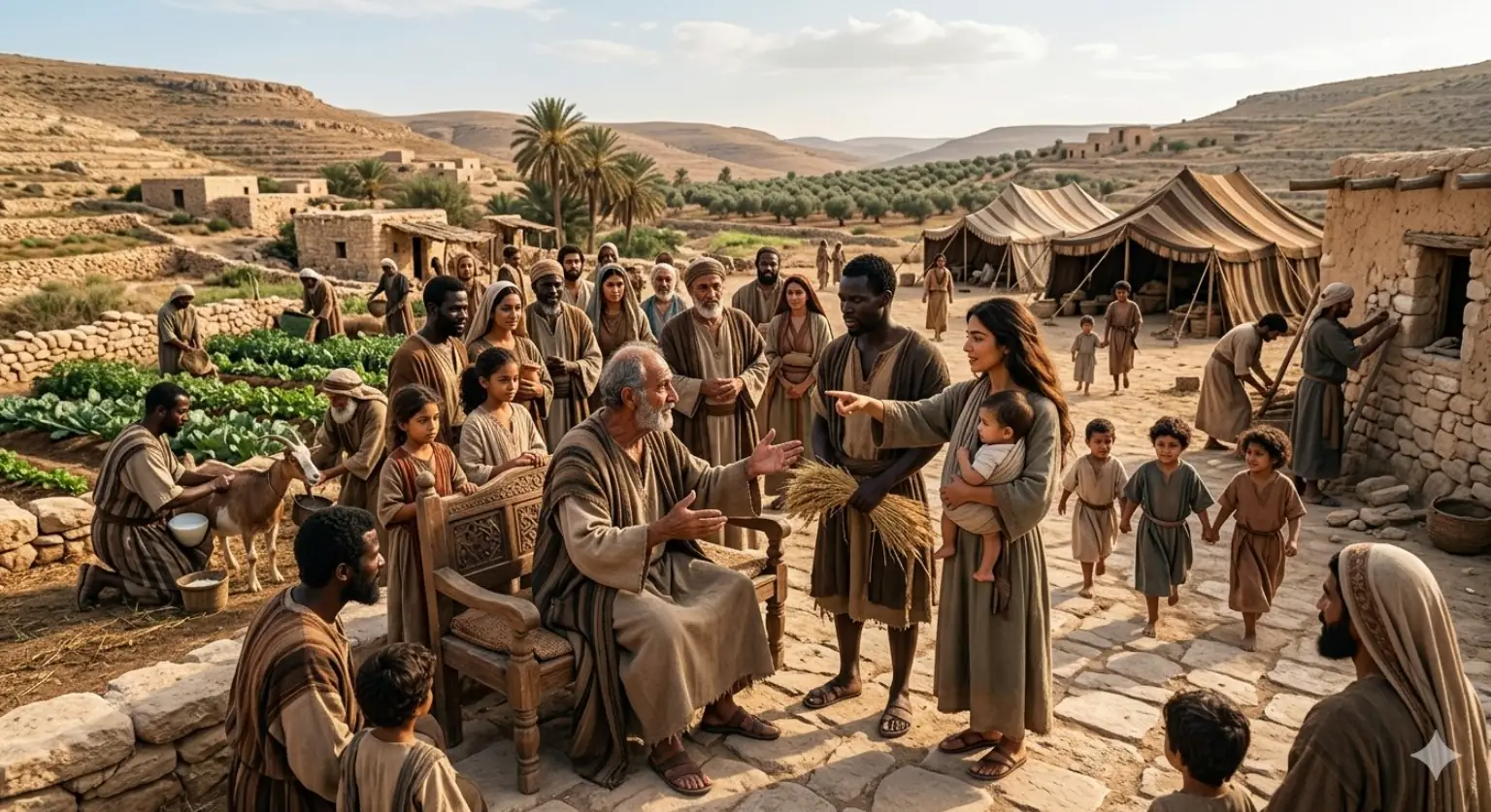
The primary theme of Genesis Chapter 25 centers around family legacy, generational destiny, and the prophetic clash of nations, depicted through the birth of the twin brothers Esau and Jacob, and the passing of Abraham's lineage.
Abraham's Death; Birth of Jacob & Esau
Genesis Chapter 25 covers the final years and death of Abraham, the generational line of Ishmael, and the birth and early conflict between Isaac's twin sons, Jacob and Esau.
Abraham's Final Years and Death (Verses 1–11)
Genesis Chapter 25 is a critical bridge in biblical history, marking the end of Abraham's era, the fulfillment of God's promise to Ishmael, and the turbulent start of the next generation through Isaac's twin sons, Jacob and Esau.
- New Marriage:
After Sarah's death, Abraham married Keturah.They had six sons: Zimran, Jokshan, Medan, Midian, Ishbak, and Shuah.
- Estate Distribution:
Abraham gave gifts to the sons of his concubines and sent them eastward into the hill country.He ensured Isaac remained the sole heir to the primary covenant and inheritance.
- Death and Burial:
Abraham died at the age of 175. His sons Isaac and Ishmael reunited to bury him alongside Sarah in the Cave of Machpelah.
Ishmael's Descendants (Verses 12–18)
- The Twelve Princes:
Ishmael’s lineage is recorded, listing his twelve sons who became tribal princes, fulfilling God's earlier promise to make a great nation of him.
- Lifespan:
Ishmael died at the age of 137.
The Birth of Jacob and Esau (Verses 19–26)
- Isaac's Prayer:
Isaac was 40 when he married Rebekah.Because Rebekah was barren for 20 years, Isaac prayed earnestly for her, and God enabled her to conceive.
- Struggle in the Womb:
Rebekah felt the twins fighting inside her and inquired of God.The Lord told her that two nations were in her womb and that the older brother (Esau) would serve the younger (Jacob).
- Birth:
Esau was born first, appearing red and hairy.Jacob followed immediately, holding onto Esau’s heel (which gave meaning to his name, signifying a supplanter or heel-grabber).Isaac was 60 years old at their birth.
Esau Sells His Birthright (Verses 27–34)
- Divergent Paths:
Esau grew up to be a skilled, outdoorsman hunter, while Jacob was a quiet man who stayed among the tents.Isaac favored Esau for his love of wild game, while Rebekah favored Jacob.
- The Trade:
Returning famished from the field, Esau begged Jacob for some of his red lentil stew.Jacob demanded Esau’s birthright (the privileged status and inheritance of the firstborn) in exchange.
- The Consequence:
Esau traded his lifelong spiritual and physical birthright for an immediate bowl of food.The text notes that Esau utterly despised his birthright.
The New Testiment inerpretation of Esau's decision to trade his inheritance for a meal
Esau trades his inheritance for a meal.
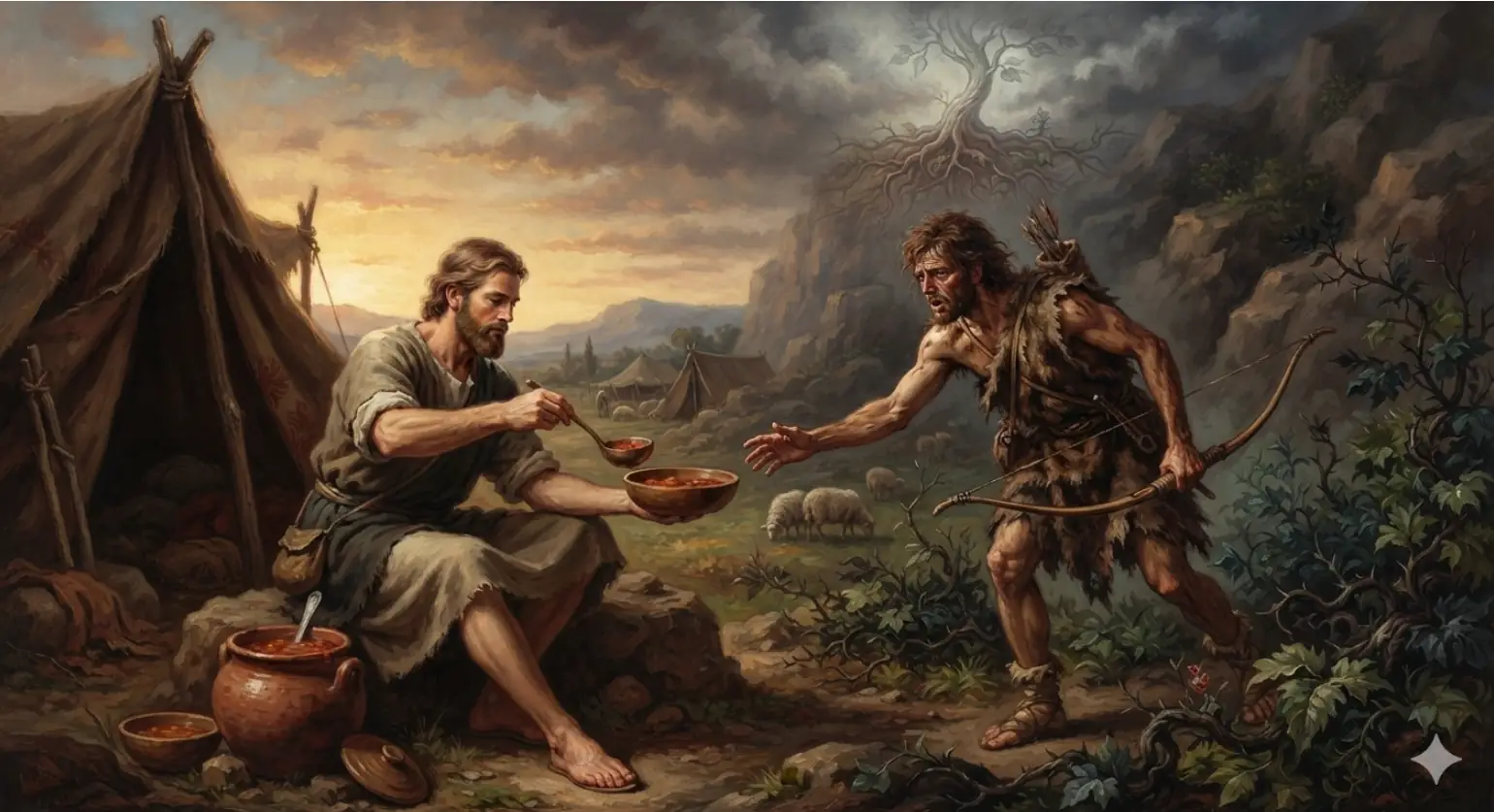
The New Testament interprets Esau’s decision to sell his birthright as a profound spiritual tragedy. It uses his choice as a stark warning against spiritual carelessness, prioritizing immediate physical desires over eternal blessings, and living a godless life
The New Testament provides two primary interpretations of Esau's decision:
- A Warning Against "Profane" Living (Hebrews 12:15–17)
- The Meaning of "Profane":
The Greek word used here is bebēlos, which means worldly, godless, or unspiritual.It refers to someone who lacks a sense of the sacred.The New Testament views Esau not merely as a hungry man making a poor choice, but as someone who weighed a permanent, divinely ordained spiritual inheritance against a single, fleeting bowl of soup—and chose the soup.
- The Irreversibility of the Choice:
Hebrews goes on to note that when Esau later wanted to inherit the blessing, he was rejected, finding "no chance to repent, though he sought it with tears."The New Testament highlights this to warn believers that rejecting God's grace for temporary comfort can lead to a hardness of heart that is devastating and permanent.
- An Example of Divine Sovereignty and Election (Romans 9:10–13)
- God's Purposes Over Human Desires:
Paul interprets the situation to show that Esau’s status as the firstborn did not guarantee him the covenant promise.
- The "Loved vs. Hated" Contrast:
In ancient Near Eastern idiom, "love" and "hate" were often used to express choosing one over another.The New Testament uses Esau’s story to illustrate that the spiritual inheritance of the covenant belongs to those chosen by God's grace, while Esau chose to walk the path of his own fleshly desires.
The most direct and explicit commentary on Genesis 25 is found in the Book of Hebrews. The author uses Esau as the ultimate example of someone who treats sacred things with contempt:
"See to it that no one fails to obtain the grace of God... that no one is sexually immoral or profane like Esau, who sold his birthright for a single meal." (Hebrews 12:15-16)
In the Book of Romans, the Apostle Paul uses the story of Esau and Jacob to explain how God's purposes operate through sovereign choice, rather than human lineage or effort:
"...though they were not yet born and had done nothing either good or bad—in order that God's purpose of election might continue, not because of works but because of him who calls—she was told, 'The older will serve the younger.' As it is written, 'Jacob I loved, but Esau I hated.'" (Romans 9:11-13)