Today's date is: September 19, 2026
Genesis Chapter 4
📝Summary
Genesis 4 tells the story of Cain and Abel, the first recorded murder in human history, and the early expansion of humanity.
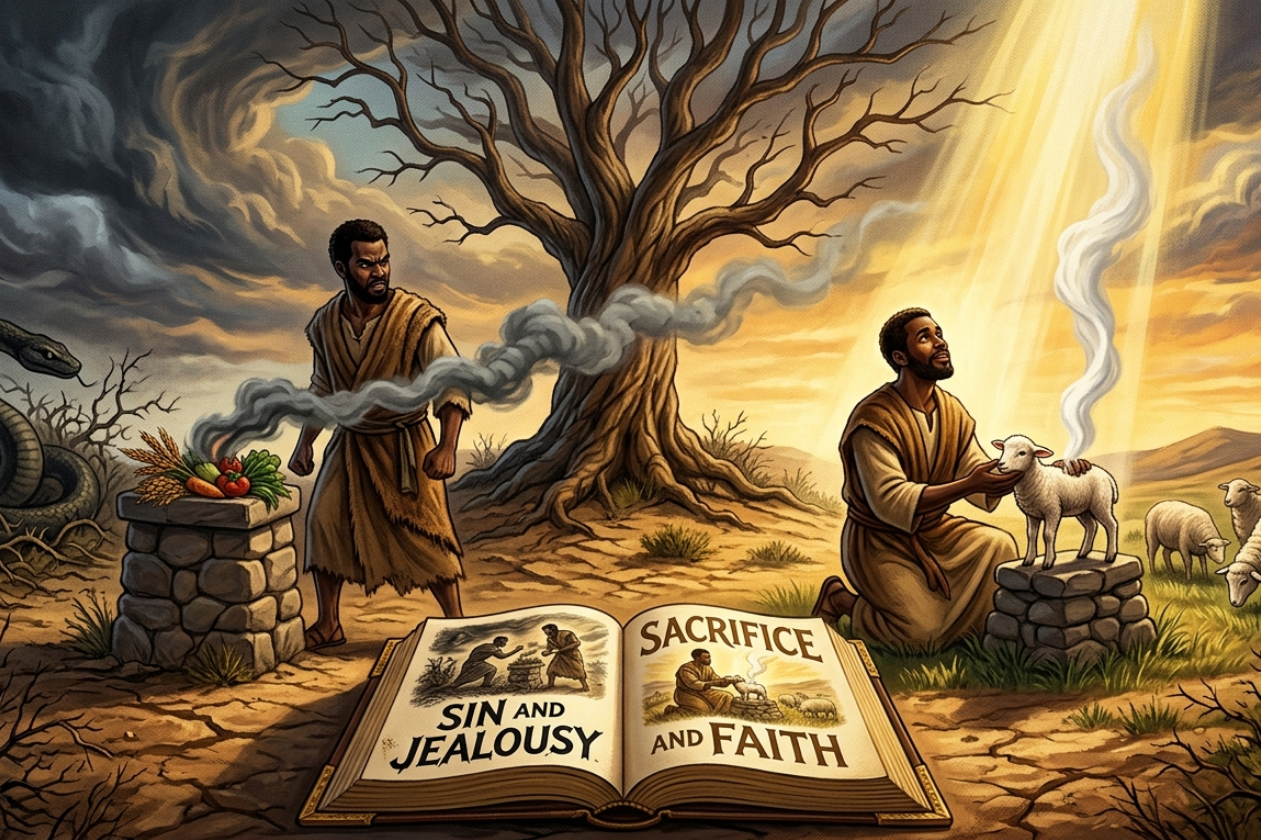
- The Birth of Cain and Abel
- Firstborn children: Eve conceives and bears Cain, believing with the Lord's help she has acquired a man, followed by his brother Abel.
- Different vocations: Abel becomes a shepherd (keeper of flocks), while Cain works as a farmer (tiller of the ground).
- The Offerings and God's Warning
- The sacrifices: Cain brings an offering of the fruit of the ground, while Abel brings the firstborn fat portions of his flock.
- God's acceptance: God regards Abel and his offering with favor, but does not regard Cain and his offering.
- Sin at the door: When Cain grows angry and dejected, God warns him that doing right leads to acceptance, but unchecked sin crouches at the door like a beast desiring to master him.
- The First Murder and Judgment
- The killing: Rejecting the warning, Cain lures Abel into a field and kills him, committing history's first murder.
- Divine interrogation: When God asks where Abel is, Cain deflects responsibility with the defiant question, "Am I my brother's keeper?"
- The curse: God curses Cain from the fertile ground, turning him into a restless wanderer, yet places a protective mark on him so no one will kill him in vengeance.
- Cain's Descendants and the Line of Seth
- Urbanization and culture: Cain settles in the land of Nod ("wandering"), builds a city named after his son Enoch, and his descendants pioneer nomadic tent-living, musicianship, and metalworking (Lamech, Tubal-Cain).
- Escalating violence: Lamech boasts of murder and claims a massive seventy-sevenfold vengeance, showing how human malice multiplies.
- A new hope: Adam and Eve have a third son, Seth, whose own lineage marks a turning point where mankind begins to formally call upon the name of the Lord.
 How Do I Apply Genesis 4 to My Life Today
To apply Genesis Chapter 4 to your life today, look beyond the surface of the world's first murder and examine the everyday attitudes of the heart. The narrative of Cain and Abel provides highly actionable lessons on dealing with modern temptation, relationship conflicts, and spiritual integrity.
- Give God Your Best, Not Your Leftovers
- Today's Application: Evaluate what you give to God. Avoid giving Him your leftover time, energy, or money at the end of a exhausting day or month. Prioritize spending your freshest, highest-energy moments in prayer or reading Scripture, and commit your resources intentionally.
- Recognize and Subdue "Crouching" Sins
- Today's Application: Guard your thought life. When you notice anger, jealousy, or resentment bubbling up, do not entertain or feed it. Acknowledge it immediately and proactively choose to rule over it before it transforms into destructive words or actions.
- Take Responsibility—You Are Your Brother’s Keeper
- Today's Application: Reject modern hyper-independence and indifference. You are spiritually and socially responsible for looking out for the well-being of the people around you—your family, neighbors, and coworkers. Actively check in on others and stand up for those who are vulnerable.
- Own Your Mistakes Instead of Deflecting
- Today's Application: Practice radical accountability. When your faults or mistakes are exposed by a loved one, a friend, or your conscience, resist the urge to blame external circumstances. Confess your missteps honestly, accept the consequences gracefully, and lean into repentance.
- Choose the Path of Faith Over Empty Religion
- Today's Application: Focus on your internal motivation over external appearances. Going to church, volunteering, or checking off a spiritual to-do list means very little if your heart is harbor-ing underlying self-righteousness or unresolved malice. Keep your heart posture humble and dependent on God.
Cain brought a generic "offering of the fruit of the ground," while Abel brought the "firstborn of his flock and of their fat"—meaning Abel prioritized God with his absolute finest.
When Cain grew bitter, God issued a famous warning: "Sin is crouching at the door. And its desire is for you, but you should rule over it". Sin is depicted as a predator waiting for the right moment to pounce.
When God asked where Abel was, Cain deflated the conversation with a sarcastic lie: "I do not know. Am I my brother's keeper?". The ultimate scriptural answer to his question is a resounding yes.
When confronted by God, Cain denied reality, grew defensive, and complained that his punishment was unfair rather than showing genuine remorse.
The New Testament (Hebrews 11:4) notes that Abel’s offering was accepted because it was offered "by faith". Cain went through the motions of worship but lacked a heart aligned with God.