Today's date is: September 19, 2026
Genesis Chapter 14
Summary
Genesis Chapter 14 is a fast-paced narrative detailing the first war recorded in the Bible, culminating in Abram's rescue of his captured nephew Lot and a significant spiritual encounter with the mysterious priest-king Melchizedek.
The chapter highlights Abram's growing military influence, his ultimate loyalty to family, and his refusal to profit from worldly kings at the expense of his dependence on God
📖 Detailed Analysis of Genesis Chapter 14
The chapter can be broken down into three distinct movements:
- the War of the Kings
- Abram’s rescue mission
- aftermath involving two contrasting rulers.
⚔️ The War of the Kings (Genesis 14:1–12)
The chapter opens with a regional conflict between two powerful coalitions of city-states.
Five local kings in the Jordan plain (including the kings of Sodom and Gomorrah) rebelled after 12 years of paying tribute to Chedorlaomer, the powerful king of Elam.
- The Four Eastern Kings (The Oppressors): Led by Chedorlaomer of Elam, alongside Amraphel of Shinar, Arioch of Ellasar, and Tidal of Goiim.
- The Five Western Kings (The Rebels): The rulers of Sodom, Gomorrah, Admah, Zeboiim, and Bela (Zoar).
Chedorlaomer and his allies marched south, crushing various tribal groups along the way before meeting the rebel kings in the Valley of Siddim (the Salt Sea region).
The five local kings were soundly defeated, with many falling into the valley's tar pits while fleeing.
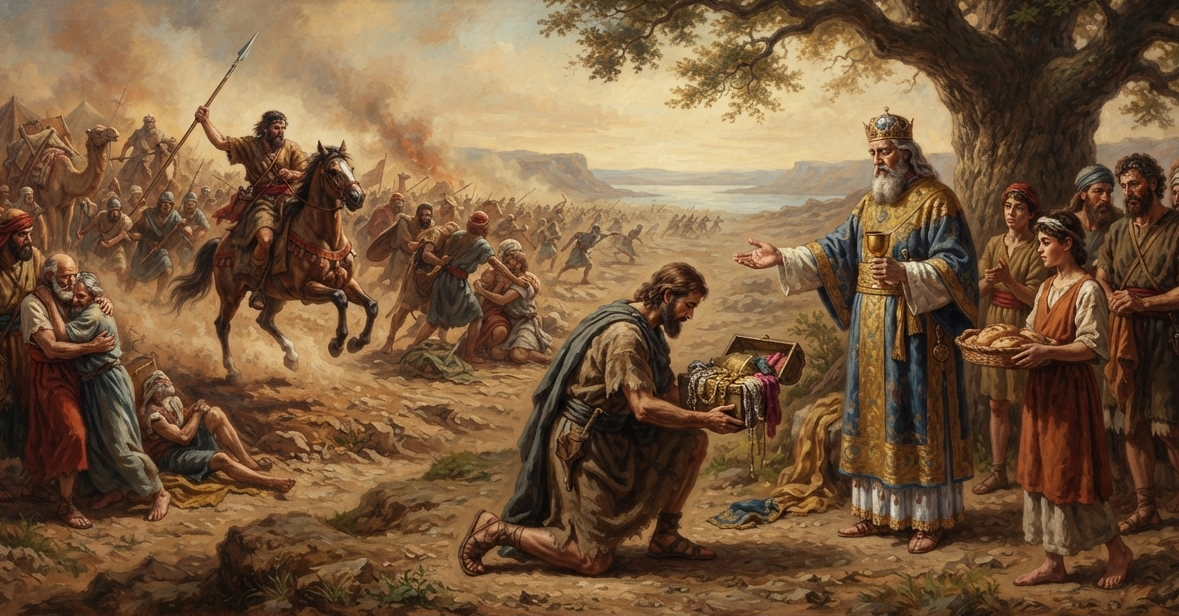
The Eastern kings plundered Sodom and Gomorrah, carrying away all their goods—and crucially, Abram’s nephew, Lot, who had chosen to live near Sodom.
🛟 Abram’s Daring Rescue Mission (Genesis 14:13–16)
The chapter opens with a regional conflict between two powerful coalitions of city-states.
Five local kings in the Jordan plain (including the kings of Sodom and Gomorrah) rebelled after 12 years of paying tribute to Chedorlaomer, the powerful king of Elam.
- The Four Eastern Kings (The Oppressors): Led by Chedorlaomer of Elam, alongside Amraphel of Shinar, Arioch of Ellasar, and Tidal of Goiim.
- The Five Western Kings (The Rebels): The rulers of Sodom, Gomorrah, Admah, Zeboiim, and Bela (Zoar).
Chedorlaomer and his allies marched south, crushing various tribal groups along the way before meeting the rebel kings in the Valley of Siddim (the Salt Sea region).
The five local kings were soundly defeated, with many falling into the valley's tar pits while fleeing.
The Eastern kings plundered Sodom and Gomorrah, carrying away all their goods—and crucially, Abram’s nephew, Lot, who had chosen to live near Sodom.
👑 The Encounter with Two Kings (Genesis 14:17–24)
Upon his victorious return, Abram was met by two fundamentally different rulers in the Valley of Shaveh, setting up a sharp theological and moral contrast.
| The King | Identity & Demeanor | Abram's Response |
|---|---|---|
| Melchizedek(King of Salem) | His name means "King of Righteousness," and Salem means "Peace" (proto-Jerusalem). He was a unique priest-king of God Most High (El Elyon) who brought out bread and wine and blessed Abram. | Abram recognized his spiritual authority and gave him a tenth (a tithe) of all the spoils. |
| King of Sodom(Bera) | Ruler of a notoriously wicked city. He approached Abram with a transactional offer: "Give me the people, but take the goods for yourself." | Abram flatly refused to take even a thread or a sandal strap. He swore an oath to God Most High that he would not let a wicked king claim, "I made Abram rich." |
💡 Key Themes & Theological Significance
Upon his victorious return, Abram was met by two fundamentally different rulers in the Valley of Shaveh, setting up a sharp theological and moral contrast.
- The Faith and Character of Abram:
Abram is vindicated as a selfless leader.He risks his life for a nephew who had previously slighted him, shows tactical brilliance, and demonstrates radical integrity by rejecting blood money from Sodom.
- The Sovereignty of God Most High (El Elyon):
Melchizedek contextualizes the victory.It wasn't just Abram's tactics that won the day; it was God who delivered the enemies into his hand, fulfilling the Genesis 12 covenant promise to protect Abram.
- The Foreshadowing of Christ:
Melchizedek serves as a massive theological archetype.As a king without a recorded genealogy who is simultaneously a high priest, he prefigures Jesus Christ.This connection is explicitly detailed later in the New Testament within Hebrews Chapter 7.