Today's date is: September 19, 2026
Genesis Chapter 12
📝Summary
Genesis Chapter 12 marks one of the most critical turning points in the Bible, shifting the narrative focus from universal human history to the story of one man and his descendants. The chapter details the call of Abram (later Abraham), the initiation of the Abrahamic Covenant, and a testing of Abram's faith during a severe famine in Egypt.
📖 Detailed Analysis of Genesis Chapter 12
- 🧭 The Call and the Sevenfold Promise (Genesis 12:1–3)
- "I will make you into a great nation" – A promise of numerous descendants, contrasted heavily by the fact that his wife Sarai was barren.
- "I will bless you" – Material and spiritual prosperity.
- "I will make your name great" – A direct reversal of the Tower of Babel, where humanity tried and failed to make a name for themselves through pride.
- "You will be a blessing" – Abram is not just a recipient of grace, but a pipeline for it.
- "I will bless those who bless you" – Divine alignment with Abram's allies.
- "Whoever curses you I will curse" – Divine protection against enemies.
- "All peoples on earth will be blessed through you" – The ultimate global objective of the covenant.
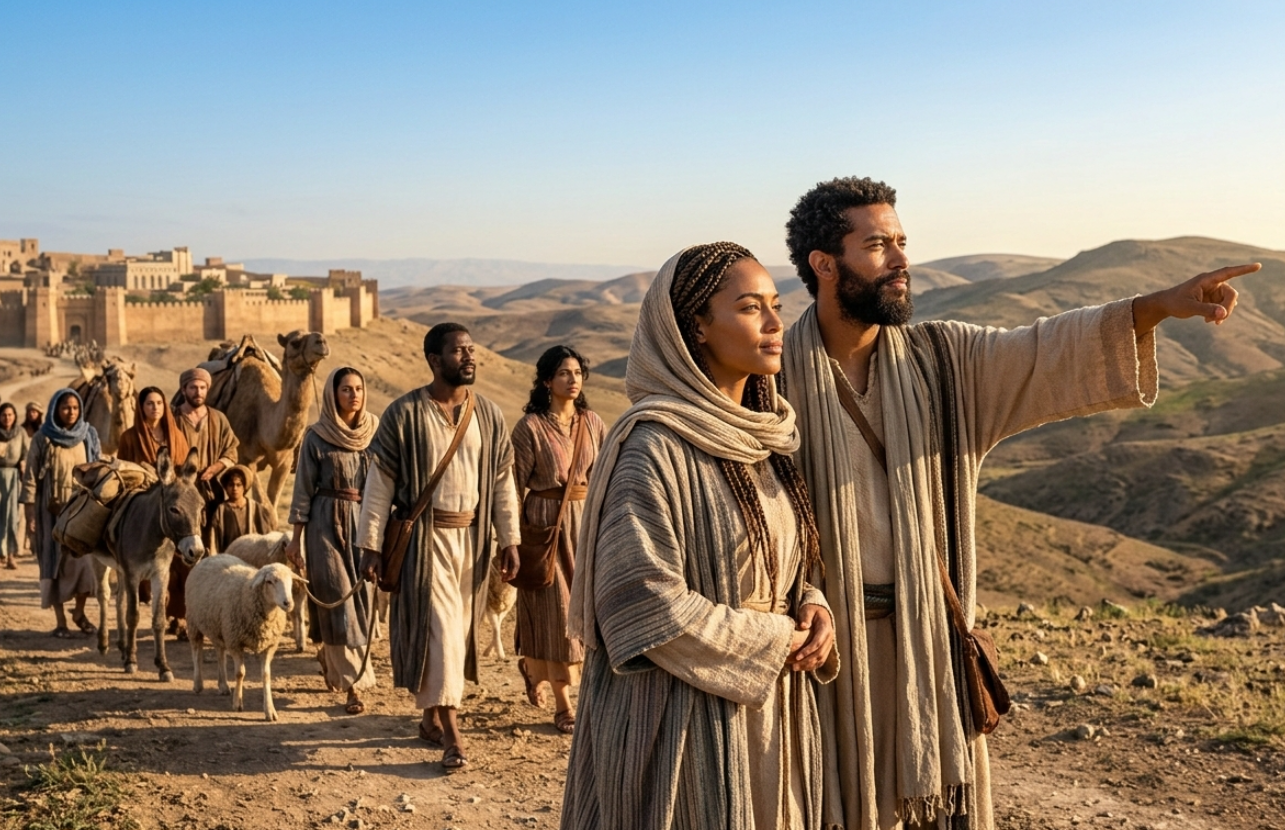
- 🥾 Abram's Journey and Worship in Canaan (Genesis 12:4–9)
- 🏜️ Failure in Egypt: The Sister Deception (Genesis 12:10–20)
- The Compromise: Pharaoh takes Sarai into his royal palace to be part of his harem, unknowingly committing an offense against marriage. Meanwhile, Abram profits immensely, receiving livestock and servants from Pharaoh as bridal gifts.
- The Plagues: To preserve the bloodline and His ultimate covenant, God intervenes by striking Pharaoh’s household with terrible plagues.
- The Rebuke: Upon discovering the truth, Pharaoh—a pagan king—righteously rebukes Abram for his dishonesty. Pharaoh returns Sarai and expels them from Egypt, though Abram is allowed to keep the massive wealth accumulated during the ordeal.
- 🎯 Key Theological Themes
- Divine Initiative vs. Human Merit: God does not choose Abram because he is perfect or holy. Abram is an elderly man with a barren wife who falters into cowardice under pressure. God's covenant rests entirely on His own sovereign grace.
- The Progression of Faith: Faith is a muscle that grows. Abram displays magnificent, world-altering faith by leaving Haran, but displays weak, trembling faith when facing famine.
- The Messiah Anticipated: The final promise that "all peoples on earth will be blessed through you" points directly forward to Jesus Christ. New Testament writers (such as Galatians 3:8) view this verse as the very first announcement of the Gospel, fulfilling itself 2,000 years later when Christ died for the sins of the world.
The chapter opens with a radical divine command that requires total uprooting and absolute trust:
“Go from your country, your people and your father's household to the land I will show you.” — Genesis 12:1 (NIV).
God demands that Abram sever three layers of security: his nation, his extended kinship network, and his immediate ancestral home. In the ancient world, these ties provided identity, safety, and economic survival.
In exchange for this radical obedience, God counterbalances the command with an unconditional sevenfold covenantal promise:
At 75 years old, Abram obeys, departing Haran with his wife Sarai, his possessions, and his nephew Lot. Bible commentators often note that bringing Lot represents partial obedience, as God had commanded him to leave his relatives behind.
| Geography / Station | Textual Element | Theological Significance |
|---|---|---|
| Shechem / Oak of Moreh | God appears and says, "To your offspring I will give this land." Abram builds his first altar. | Ownership claimed. Even though the hostile Canaanites still occupied the territory, Abram claims the promise through worship. |
| Hills East of Bethel & Ai | Abram pitches his tent and builds another altar, calling on the name of the Lord. | The Walk of Faith. The tent represents his status as a temporary nomad in this world; the altar signifies his permanent devotion to God's agenda. |
| The Negev (South) | Abram continues journeying further south into the arid desert regions. | Progressive Guidance. He moves step-by-step through the geography, walking out the length of his future inheritance. |
Abram's faith is immediately tested by a severe famine in Canaan, prompting him to travel south to Egypt.
“Abram begins to worship the Lord, but quickly fails a test of his faith in Egypt.”
Fearing that the Egyptians would kill him to acquire his beautiful wife Sarai, Abram instructs her to claim she is his sister. While technically a half-truth (Genesis 20:12), it was an intentional deception born out of self-preservation rather than trust in God's protective promise.
The Fallout and Divine Intervention
