Today's date is: September 19, 2026
Genesis Chapter 13
📝Summary
Genesis Chapter 13 describes the peaceful separation of Abram and Lot due to their vast wealth, Lot's choice of the fertile Jordan valley near Sodom, and God's renewed covenant promise to give the land to Abram and his countless descendants.
📖 Detailed Analysis of Genesis Chapter 13
Genesis 13 serves as a critical turning point in the Abrahamic narrative, tracing Abram’s spiritual recovery from his failure in Egypt, the relational fracture with his nephew Lot, and the subsequent expansion of God's covenantal promises.
Structurally and visually, the narrative functions like a chiasm framed by worship, using geography as a literary canvas to contrast the pathways of faith and sight.
- 🧬Structural Overview
- 📜Exegetical and Narrative Analysis
- Geography as Theology: Retracing his steps is a physical manifestation of repentance.
The narrative emphasizes that “Abram explicitly returns to the former altar and calls on the Lord's name, displaying renewed dependence and worship.” - The Burden of Riches: The text notes that Abram was “very rich in livestock, in silver, and in gold” (v. 2).
However, the narrator establishes a brilliant subtext: wealth is a byproduct of God’s protective hand in Egypt, not a justification of Abram's past deception. - The Model of Humility: As the elder patriarch and the explicit bearer of the covenant, Abram holds all legal and cultural rights to claim priority.
Instead, he forfeits his rights to maintain familial harmony, declaring, "Let there be no strife between you and me... for we are brothers" (v. 8). - Surrender to Providence: Abram's willingness to give Lot first choice reveals a profound spiritual growth.
Having learned in Egypt that grasping for self-preservation leads to disaster, he now leaves his geographic destiny entirely in the hands of God. - The Trap of Appearance: The allusion to Egypt is a deliberate warning flag. Lot choice is driven by a longing for the comfortable, self-sufficient affluence he witnessed during their regular detour from the promised land.
- The Literary Motif of the East: Lot journeys east (v. 11). In the structural architecture of Genesis, moving east consistently symbolizes a departure from the presence of God. Adam and Eve were driven east out of Eden; Cain fled east; the builders of the Tower of Babel journeyed east.
- Narrative Irony: The narrator masterfully cuts through the lush landscape description with an ominous reality check: “The land Lot chooses appears lush and prosperous, but the narrator immediately reminds us that 'the men of Sodom were wicked, great sinners against the LORD'” — [Explaining the Book]. Lot's choice is a gradual compromise—he begins by choosing the plain, then pitches his tent near Sodom, laying the groundwork for his eventual assimilation and entrapment within the city.
- The Unconditional Grant: God tells Abram to look north, south, east, and west. The entire land—including the very plains Lot just tried to claim for himself—is promised to Abram and his offspring forever (v. 15).
- The Hyperbolic Promise: God declares that Abram’s descendants will be as numerous as the dust of the earth (v. 16). This is highly provocative narrative irony: Abram is an aging, childless man, yet he is given a promise of infinite legacy.
- The Walk of Ownership: God bids Abram to “Arise, walk through the length and the breadth of the land, for I will give it to you.” Abram moves his tents to the oaks of Mamre at Hebron, marking his permanent settlement in the heart of Canaan. True to his restored character, the chapter concludes with Abram building yet another altar to worship the Lord.
- Key Theological Themes
- Walking by Faith vs. Walking by Sight: This chapter is the ultimate biblical paradigm of this dichotomy. Lot looks with physical eyes and chooses moral ruin; Abram waits on God’s vision and inherits eternity.
- Sovereign Grace over Human Failure: God does not abandon the covenant because Abram faltered in Egypt. Chapter 13 proves that God’s redemptive plan relies entirely on His own institutional faithfulness, not the unblemished performance of His instruments.
- The Altars vs. The Cities: Abram’s life is defined by transient tents and permanent altars of worship. Lot’s trajectory moves away from tents and altars toward the rigid, permanent, and godless security of city walls.
The 18 verses of Genesis 13 are carefully balanced to demonstrate how the subtraction of worldly entanglements leads to the expansion of divine blessings.
| Section | Focus | Theological Theme |
|---|---|---|
| Verses 1–4 | Return from Egypt to the Altar at Bethel | Repentance, restoration, and the renewal of worship. |
| Verses 5–9 | Internal Conflict & Hardship | Domestic strife as a test of material stewardship and character. |
| Verses 10–13 | The Separation of Abram and Lot | Faith vs. Sight; the moral hazards of pragmatic materialism. |
| Verses 14–18 | Renewal of the Divine Promise | God's sovereign ownership and Abram's response of permanent worship. |
❤️🩹Part 1: Restoration and the Return to Bethel (v. 1–4)
Following a famine-driven detour to Egypt where Abram compromised his integrity by lying about his wife Sarai (Genesis 12:10–20), Chapter 13 opens with a geographic and spiritual ascent.
Abram travels north out of Egypt into the Negev, journeying back to the specific altar he had previously erected between Bethel and Ai.
🏠Part 2: Domestic Strife and the Generosity of Faith (v. 5–9)
The focus shifts to Lot, whose wealth has mirrored his uncle's.
The sheer volume of their combined livestock creates an ecological and social crisis: the local pasturage cannot sustain them both, resulting in friction between Abram's herdsmen and Lot's herdsmen.
⚖️Part 3: Lot’s Choice and the Eastward Trajectory (v. 10–13)
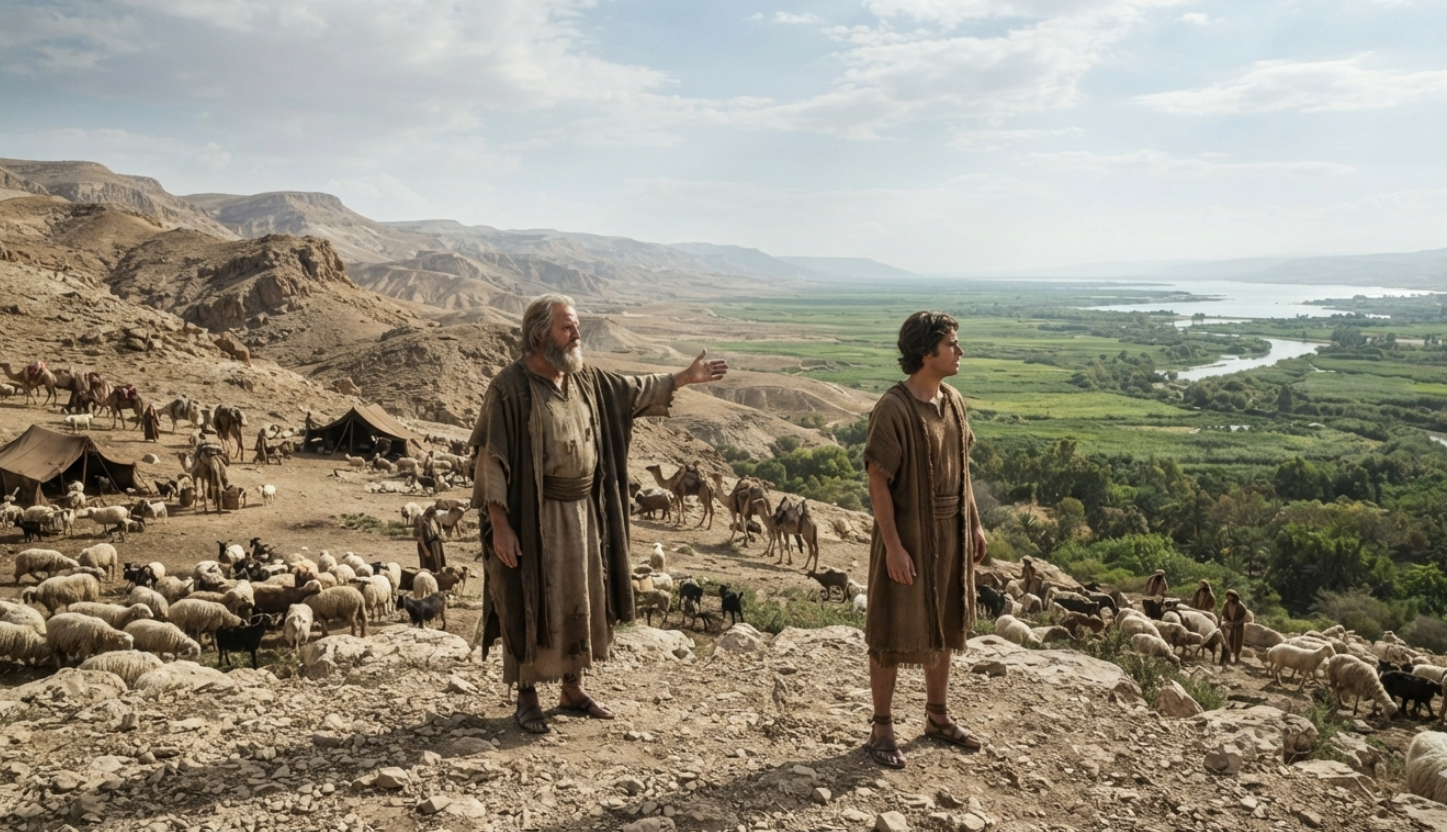
Lot evaluates the landscape purely through human calculation. He "lifts up his eyes" and sees the Jordan River Valley, noting that it was well-watered everywhere like "the garden of the Lord" and "the land of Egypt" (v. 10).
🧾Part 4: The Expanded Covenant and Permanent Altars (v. 14–18)
The moment Lot departs, removing the relational clutter and compromised presence from Abram's sphere, God breaks His silence.
God commands Abram to lift his own eyes—not to grab what he wants, but to receive what God is sovereignly bestowing.