Today's date is: September 19, 2026
Genesis Chapter 10
📝Summary
Genesis Chapter 10, commonly known as the "Table of Nations," provides a historical genealogy of the descendants of Noah’s three sons—Shem, Ham, and Japheth. It documents how humanity repopulated, branched out, and established distinct geopolitical regions, languages, and cultures across the earth following the Great Flood.
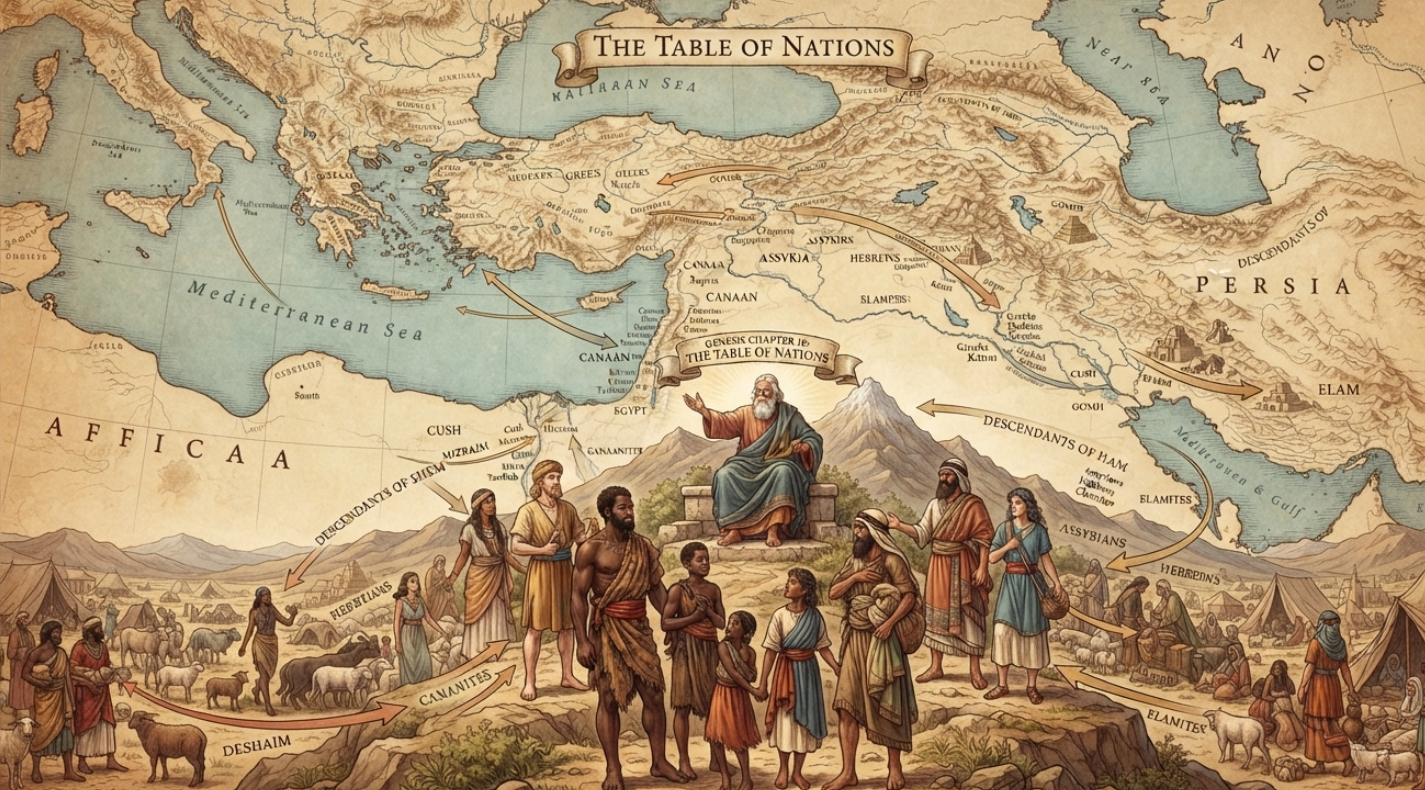
⛩ The Table of Nations
Genesis Chapter 10, traditionally known as the "Table of Nations," outlines how the earth was repopulated by the descendants of Noah’s three sons—Shem, Ham, and Japheth—following the Great Flood. Far from a tedious list of names, this chapter functions as an ancient, highly accurate anthropological map. It traces the origins of 70 distinct nations and explains how localized family clans expanded into regional superpowers.
Chronologically, Genesis 10 serves as an intentional literary bridge. It presents a high-level summary of global migration patterns, while Genesis 11 looks back to provide the specific historical catalyst for this dispersal: the confusion of languages at the Tower of Babel.
The chapter uses a strict three-fold structural hierarchy to catalog the new world order:
| Ancestor | Primary Geographic Direction | Historical & Modern Regions | Key Biblical Descendants / Entities |
|---|---|---|---|
| Japheth(vv. 2-5) | North & West | Europe, Asia Minor, Russia, and the Mediterranean coastlands | Gomer (linked to Germanic tribes), Magog (Russia), Javan (Greece), and seafaring coastland clans. |
| Ham (vv. 6–20) | South & East | North Africa, the Middle East, and the Mesopotamian plain | Cush (Ethiopia), Mizraim (Egypt), Put (Libya), Canaan, Nimrod (Babylon/Assyria), and the Philistines. |
| Shem (vv. 21–31) | Central Middle East | The Arabian Peninsula and Mesopotamian regions | Elam (Persia), Asshur (Assyria), and Eber—the linguistic and physical root of the Hebrew people. |
📉Key Figures and Highlighted Narratives
While the chapter moves quickly through names, the author deliberately pauses the lineage to spotlight two critical historical focal points:
- Nimrod: The First Global Tycoon
- Imperial Expansion:
Nimrod is credited as the architect of the world's first aggressive, centralized empire. His kingdom birthed historical strongholds like Babel (Babylon), Erech, and Akkad, before expanding north into Assyria to build Nineveh.
- Theological Meaning:
Commentators view Nimrod as a cautionary figure “whose rebellion against God established the first organized human kingdom through violence and tyranny.” He represents the emergence of humanistic pride and organized defiance against divine authority.
- The Canaanite Settlement
The genealogy pauses at Cush to introduce his son, Nimrod. He is characterized as the world's first "mighty man" and a "mighty hunter before the Lord". In the original context, this idiomatic expression denotes aggressive, imperialistic hunting of men rather than animals.
The text takes special care to plot the borders of the Canaanites, tracing them from Sidon down to Gaza, and across to Sodom and Gomorrah. This explicit mapping served an immediate purpose for the original Israelite readers leaving Egypt: it clearly identified the exact territories and regional adversaries they would encounter under Joshua during the conquest of the Promised Land.
💡Major Themes and Theological Significance
- The Blueprint of Redemptive History:
The chapter intentionally sweeps from the broad, distant nations (Japheth), transitions through Israel's future political oppressors (Ham), and progressively narrows down to the line of promise (Shem). This sets up Genesis 12, where God calls Abraham (a direct descendant of Shem's lineage through Eber) to form a nation that will ultimately bless all the global families recorded in Chapter 10.
- A Tapestry of Multi-Culturalism:
The repeating refrain—"according to their clans, their languages, their lands, and their nations"—highlights that cultural, geographical, and linguistic diversity was woven into the repopulation plan.
- Anthropological Unity:
Underneath the vast web of nations, Genesis 10 cements a foundational biblical truth: all humanity shares a single, common ancestry. Every tribe, race, and language group traces back to the exact same family cabin aboard the Ark.