Today's date is: September 19, 2026
Genesis Chapter 1
📝Summary
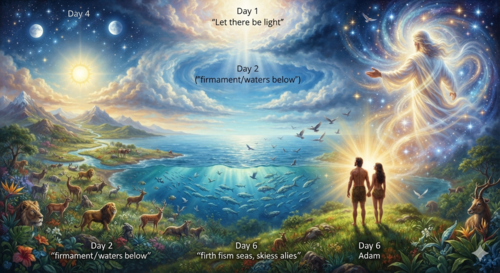
Genesis Chapter 1 serves as the foundational narrative of the our worldview, detailing how an eternal God brought order, time, space, and life out of absolute chaos.
Its primary purpose is theological and literary, written to establish God’s supreme sovereignty and humanity's unique identity.
🏛️ Literary Structure: Forming and Filling
The chapter is meticulously structured around a parallel framework.
The first three days focus on forming environments to overcome a world that was "formless" (Hebrew: tohu), while the next three days focus on filling those environments to overcome the "void" (Hebrew: bohu).
| Phase 1: Forming the Realms (Tohu) | Phase 2: Filling the Realms (Bohu) |
|---|---|
| Day 1: Light and darkness separated to create time. | Day 4: Sun, moon, and stars to rule the day and night. |
| Day 2: Waters separated by a sky dome to create space. | Day 5: Birds and sea creatures to inhabit the sky and ocean. |
| Day 3: Dry land and vegetation separated from the seas. | Day 6: Land animals and humanity to occupy the earth. |
🔍 Key Theological & Textual Themes
- Creation Ex Nihilo and Sovereignty
- The Primeval State:
Verse 2 describes the pre-creation state as dark, watery, and chaotic. God does not battle monsters or other deities to win control, which directly contrasted other ancient Near Eastern creation myths like the Babylonian Enuma Elish.
- The Divine Word:
God creates effortlessly through speech ("And God said, 'Let there be...'"). This establishes supreme authority and the concept of creation out of nothing (ex nihilo).
- The Hovering Spirit:
The phrase "the Spirit of God was hovering over the face of the waters" introduces a personal, protective presence preparing to infuse order into chaos.
- The Nature of God (The Trinity)
- Elohim:
The Hebrew word used for God here is Elohim
- Divine Multiplicity:
In verse 26, God speaks in the plural: "Let us make man in our image." We interprets this as an early, progressive revelation of the Trinity—God the Father, the hovering Spirit (v. 2), and the Word (Jesus) through whom all things were spoken into existence.
- The Imago Dei (Image of God)
- Status, Not Appearance:
Humans are created on Day 6 as the climax of creation and are uniquely designated as bearing the Imago Dei (Image of God). This is not physical appearance, but a status reflecting God's character and rule.
- The Royal Mandate:
Unlike ancient mythologies where humans were slaves to feed the gods, Genesis places humans as vice-regents given "dominion" over the earth. This mandate calls for loving stewardship, cultivation, and care of the world rather than destructive exploitation.
- Equality of Sexes:
The text specifies that both "male and female" were created in His image, establishing fundamental, ontological equality between genders from the very beginning.
- The Rhythm of Goodness and Time
- Inherent Goodness:
Throughout the creative process, God pauses to declare each element "good". Upon completing human creation on Day 6, God surveys everything and declares it "very good". The material world is fundamentally pure and intentional, not a cosmic accident or a trap for the spirit.
- The Evening and Morning:
Time is tracked starting with evening: "And there was evening, and there was morning..." In Hebrew thought, rest and darkness precede active work and light, setting up a life cadence that prioritizes trust over human striving.
 How Do I Apply Genesis 1 to My Life Today
To apply Genesis Chapter 1 to your life today, look past the grand scale of the cosmos and focus on the profound principles of structure, identity, and the intentional transition from chaos to order. This chapter provides a powerful masterclass in how to ground yourself when your external environment feels chaotic or unpredictable.
- 1. Speak Light Into the Darkness and Chaos
- Today's Application: When a situation at work or in a relationship becomes overwhelming, it can feel like a chaotic, dark fog where you can't see the next right step. Follow this design by using your words to bring light rather than throwing fuel on the fire. Speak technical facts clearly, communicate calmly under pressure, and bring clarity to misunderstandings instead of letting assumptions darken the room.
- Establish Healthy Boundaries and Separation
- Today's Application: Chaos thrives when boundaries blur. If professional stress or external blame is bleeding into your personal life and feeding a short temper, you need to actively separate them. Set firm, healthy boundaries for your mental space. When you step away from a stressful task or finish a shift, consciously separate that environment from your personal time so you can recharge in peace.
- Move Step-by-Step Instead of Demanding Instant Solutions
- Today's Application: When you feel trapped by complex problems—like a malfunctioning application that requires deep troubleshooting—resist the urge to fix everything all at once. Break the problem down into manageable days or steps. Focus entirely on documenting one error code, testing one variable, or taking one small positive action at a time. Steady, methodical progression breaks the illusion of being stuck.
- Recognize Your Inherent, Unshakable Value
- Today's Application: Your fundamental value and dignity are entirely secure and inherent. They do not depend on the flawless operation of a software program, the erratic opinions of colleagues, or how well a project goes. Knowing that your identity is anchored in something much higher gives you the resilience to withstand unfair criticism without feeling personally diminished.
- Pause to Evaluate and Validate the Good
- Today's Application: When you are under intense stress, your brain naturally hyper-focuses on what is broken, unfair, or frustrating. Actively counter this by building a daily habit of pausing to identify what is going right. Acknowledge a small technical breakthrough, a moment where you kept your composure, or a supportive connection. Intentionally naming the "good" resets your perspective and strips frustration of its power.
The chapter opens with a stark reality: the earth was "without form, and void; and darkness was on the face of the deep". God does not ignore the chaos; instead, His Spirit hovers over it, and He introduces change by speaking clear intention into existence: "Let there be light".
Creation progresses through a systematic series of separations: God separates the light from the darkness, the waters below from the sky above, and the land from the sea. Order is established entirely through clear boundaries.
God did not build the entire structured universe in a single, instantaneous flash. He worked in a deliberate, six-day progression, addressing one layer of structure at a time before moving to the next.
God creates humanity as the pinnacle of the narrative, declaring, "Let Us make man in Our image, according to Our likeness". This identity is bestowed before human beings have accomplished a single task, performed any work, or earned approval.
At the conclusion of each day's work, God explicitly pauses, looks at what has been formed, and reflects: "And God saw that it was good." At the very end, He looks at the complete picture and calls it "very good."