Last edited on: August 30, 2026, 9:10 am
Isaiah Chapter 12 Review
Summary:
Isaiah chapter 12 is a short, joyful hymn of praise and thanksgiving.
It serves as a concluding response to the prophecies of restoration and the coming Messiah in chapter 11.
The chapter records a future song of God’s people.
They celebrate that God's anger has turned into comfort, declare trust instead of fear, and resolve to share God’s great deeds with the whole world.
| Theme | Biblical Significance in Chapter 12 |
|---|---|
| The Character of Salvation | Salvation is revealed not as a dry theological concept, but as a person—God Himself is the source of strength and song. |
| Relational Restoration | True peace occurs when judgment passes and God comforts His people, dwelling actively in their midst. |
| Global Witness | Experiencing God's deliverance naturally compels the believer to share His deeds with surrounding nations. |
The metaphors of water, joy, and salvation in Isaiah 12 connect directly to Jesus’s ministry in the New Testament, most notably during the Feast of Tabernacles (Sukkot) in the Gospel of John.
Jesus explicitly claims to be the fulfillment of the "wells of salvation" described by the prophet.
The Historical Context: The Water Libation Ceremony
To see the connection, it helps to understand a major Jewish ritual practiced in Jerusalem during Jesus's time.
- The Ritual:
Every year during the Feast of Tabernacles, the High Priest led a joyful procession down to the Pool of Siloam.
- The Action:
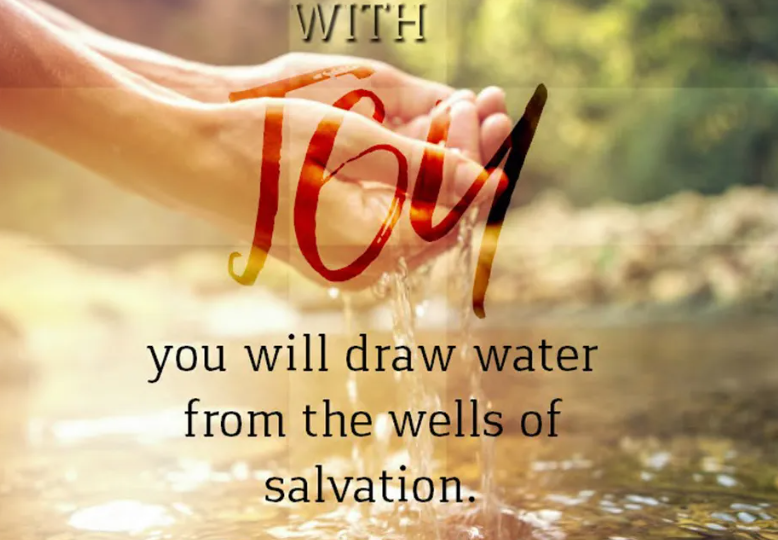
The priest filled a golden pitcher with water while the crowds chanted Isaiah 12:3: "With joy you will draw water from the wells of salvation."
- The Purpose:
They marched back to the Temple and poured the water out onto the altar as a prayer for rain and a celebration of God’s provision.
Key Connections in the New Testament

- Jesus’s Declaration at the Temple (John 7:37–39)
- The Samaritan Woman at the Well (John 4:10–14)
- He tells her that physical water only satisfies temporarily, but the water He gives becomes "a spring of water welling up to eternal life."
- Just as Isaiah 12 describes drawing water with joy, Jesus promises a permanent, internal source of joy and life that eliminates spiritual emptiness.
- The Linguistic Connection: "God is My Salvation"
- In the New Testament, when the angel commands Joseph to name Mary's baby, he says, "You shall call his name Jesus, for he will save his people from their sins" (Matthew 1:21).
- Jesus's actual Hebrew name is Yeshua.
Every time a New Testament believer spoke His name, or an Old Testament worshiper sang Isaiah 12:2, they were literally proclaiming: "God is Jesus."
- The Inhabitant of Zion (Isaiah 12:6 vs. John 1:14)
- The Apostle John mirrors this language to describe Jesus's birth: "The Word became flesh and dwelt [tabernacled] among us" (John 1:14).
- The metaphor of God physically dwelling in the midst of His people as a source of comfort is realized in the Incarnation of Jesus.
On the final, greatest day of the Feast of Tabernacles—likely right as this water ritual was reaching its climax—Jesus stood up in the Temple courts and shouted to the crowd:

By doing this, Jesus boldly redirected the crowd's attention away from the physical ritual and onto Himself.
He declared that He is the true "well of salvation" Isaiah prophesied about, and the Holy Spirit is the living water that satisfies eternal spiritual thirst.
Jesus uses the exact same imagery during a private conversation with a Samaritan woman drawing physical water.
In Isaiah 12:2, the Hebrew word used for salvation is Yeshua ("Behold, God is my yeshua...").
Isaiah closes his song by telling the people to shout for joy because the "Holy One of Israel is among you."
Overview
Isaiah Chapter 12 is a short, six-verse hymn of praise and thanksgiving that celebrates the ultimate salvation and comfort provided by God.
It serves as the grand climax to the first major section of the Book of Isaiah (Chapters 1–12), concluding a series of intense prophecies regarding judgment, the Assyrian invasion, and the promise of a future Messiah.
Literary Context
- The Messianic Link:
Chapter 12 directly answers the prophetic promises of Isaiah Chapter 11.
After outlining the arrival of the "Branch from the stump of Jesse" (the Messiah) and His peaceful kingdom, Chapter 12 functions as the joyful song that the redeemed will sing "in that day".
- A New Exodus:
The language strongly mirrors the Song of Moses from Exodus 15.
It acts as a victory anthem for a "new exodus," where God gathers His remnant back from captivity.
- The Structural Transition:
This chapter wraps up the initial segment of Isaiah's writings.
Immediately following this song, Chapter 13 shifts toward heavy oracles and judgments against foreign nations.
Structural Breakdown
The chapter is divided into two distinct perspectives of praise: an individual testimony followed by a corporate call to worship.
Isaiah Chapter 12

- Personal Testimony of Conversion (Verses 1–3)
- Anger Turned Away: The speaker acknowledges that while God was rightfully angry due to their sins, His wrath has subsided and turned into divine comfort.
- Trust Replaces Fear:
The worshiper declares, "Behold, God is my salvation; I will trust and not be afraid".
Safety is found in God's character, not in human works or military alliances.
- The Wells of Salvation:
Verse 3 uses a famous metaphor: "With joy you will draw water from the wells of salvation."
In an arid ancient Near East, water symbolized life, refreshment, and spiritual satisfaction.
- Global Proclamation of Praise (Verses 4–6)
- Declaring His Deeds:
The saved are instructed to make God's glorious acts known throughout the earth and to remind the world that His name is exalted.
- Shouting for Joy:
The final verse commands the "inhabitants of Zion" to cry aloud and shout because the "Holy One of Israel" physically dwells among them.
The section begins with an individual speaking to God, shifting from experiencing His discipline to receiving His comfort.
The perspective expands from the individual to a plural corporate community ("you all") calling on each other to evangelize the nations.
Applying Isaiah Chapter 12 to My Life Today
To apply Isaiah Chapter 12 to your life today, you must shift your focus from personal anxieties to intentional worship and public gratitude.
This short, powerful six-verse chapter functions as a hymn of praise, modeling how a believer should respond after experiencing God's mercy and deliverance.
- Actively Receive and Meditate on God's Mercy
- Acknowledge the shift:
Remind yourself daily that through faith in Christ, God's righteous anger over sin has turned away.
- Embrace true comfort:
Actively choose to rest in His peace rather than carrying guilt, knowing He has uniquely comforted you.
- Personalize the truth:
Read verse 1 out loud as a personal declaration of your status before God.
- Trade Personal Fear for Divine Trust
- Declare your security:
Memorize verse 2: "Surely God is my salvation; I will trust and not be afraid"
- Lean on His energy:
When facing stress, verbally declare that God is your strength and defense rather than relying on your own power.
- Anchor your confidence:
Treat God Himself as the ultimate source of your stability, not your circumstances.
- Intentionally Drink From the "Wells of Salvation"
- Create daily habits:
Spend dedicated time alone in prayer, scripture reading, and reflection to draw spiritual water.
- Maintain continuous joy:
Do not treat your faith as a checklist; intentionally enjoy your relationship with God throughout the day.
- Refuse broken cisterns:
Stop looking to worldly approval, entertainment, or material possessions to satisfy your spiritual thirst.
- Transition from Private Faith to Public Praise
- Verbally give thanks:
Look for direct opportunities to vocalize what God has done in your life to family or friends.
- Make His deeds known:
Share your testimony or stories of answered prayers naturally in your workplace, home, or community.
- Exalt His reputation:
Focus your conversations on highlighting God's good character rather than venting about life's difficulties.
- Prioritize Communal Worship
- Gather with believers:
Commit to regular corporate worship, moving the focus from individual devotion to a shared community.
- Sing with expression:
Lift your voice and participate fully in musical worship, remembering that God is present "in the midst" of His people.
- Celebrate His greatness:
Let your shared worship be energetic, filled with joy, and clear to anyone observing from the outside.